The stories the city told about itself
Athens in Myth and Legend
Before Athens was history, it was a story: a goddess and a god competing for a rock, a people born from the soil, and a festival that turned the whole city into a stage. Those myths still explain what you are looking at on the Acropolis today.
The contest on the rock: Athena, Poseidon, and an olive tree
Every great city needs an origin story, and Athens chose one about a decision. In the founding myth, Athena and Poseidon both wanted to be the patron of the new settlement on the rock, so they competed with gifts. Poseidon struck the stone with his trident and produced a spring of salt water — raw, dramatic, a show of force. Athena planted an olive tree. The Athenians, asked to judge, chose the olive: oil, food, light, trade, and a tree that keeps giving for generations. The city took her name.
It is worth pausing on what that choice says. The Athenians did not crown the god of brute power and the open sea; they crowned the goddess of wisdom, craft, and the cultivated, patient yield of the olive. The myth is a self-portrait — a community that wanted to see itself as clever rather than merely strong, and that read its own prosperity as the reward for good judgement.
You can stand at the exact stage set for this story. The Erechtheion, the elegant temple on the north side of the Acropolis, was built over the spot where the contest was said to have happened. It enshrined the sacred olive tree of Athena, the marks left by Poseidon's trident in the rock, and a salt spring — physical relics of a legend, treated by the ancient city as real and worth a temple.
Children of the soil: Kekrops, Erichthonios, and the claim of autochthony
Athenian myth doubled down on belonging. Their legendary first kings — Kekrops, often pictured as half-man, half-serpent, and the earth-born child Erichthonios, raised by Athena herself — anchored a powerful idea the Athenians called autochthony: that they had not migrated in from somewhere else but had sprung directly from the soil of Attica. They were, the story insisted, children of the land they stood on.
This was more than folklore; it was political identity. In a Greek world of restless settlers and rival city-states, autochthony let Athenians claim a unique authenticity — a people as native to their rock as the olive that grew on it. It is a thread that runs straight from the mythic kings to the classical city's confidence in itself, and it is part of why the Erechtheion honoured these ancient, half-legendary founders alongside the gods.
Read this way, the Acropolis is not only a religious sanctuary. It is the place where Athens kept the documents of its own descent, told in stone instead of writing.
The Panathenaia: the city as a procession
The myths were not left on a shelf; they were performed. The Panathenaia, held in honour of Athena, was the city's greatest festival — a great procession that climbed from the lower town up to the Acropolis, carrying a newly woven robe, the peplos, as a gift to the goddess, alongside athletic and musical contests. Every few years the Greater Panathenaia turned the whole route into a single civic ritual.
You do not have to imagine it from scratch, because the Athenians carved it. The Parthenon frieze — the long band of relief sculpture that ran around the temple, designed in the circle of Pheidias — is widely read as a depiction of the Panathenaic procession: riders and elders, water-carriers and sacrificial animals, the people of Athens turned into marble and led toward the gods. Much of what survives is now displayed in the Acropolis Museum, where you can follow the procession block by block.
The deeper point is what the festival reveals about Athens itself: a place where the city was its own theatre. Worship, politics, competition, and community were not separate compartments but a single public performance, staged on the rock for everyone to see and join.
Poseidon's other temple: the legend on the edge of Attica
Athena may have won the rock, but Poseidon was never far from the Athenian imagination — and the coastline kept his stories. Athens was a sea power, and its myths reached out across the water to islands and shrines that a visitor can still follow. Many of those threads — Theseus and the labyrinth, the heroes who sailed out and the ships that came home — belong as much to the Cyclades and the Saronic Gulf as to the city itself.
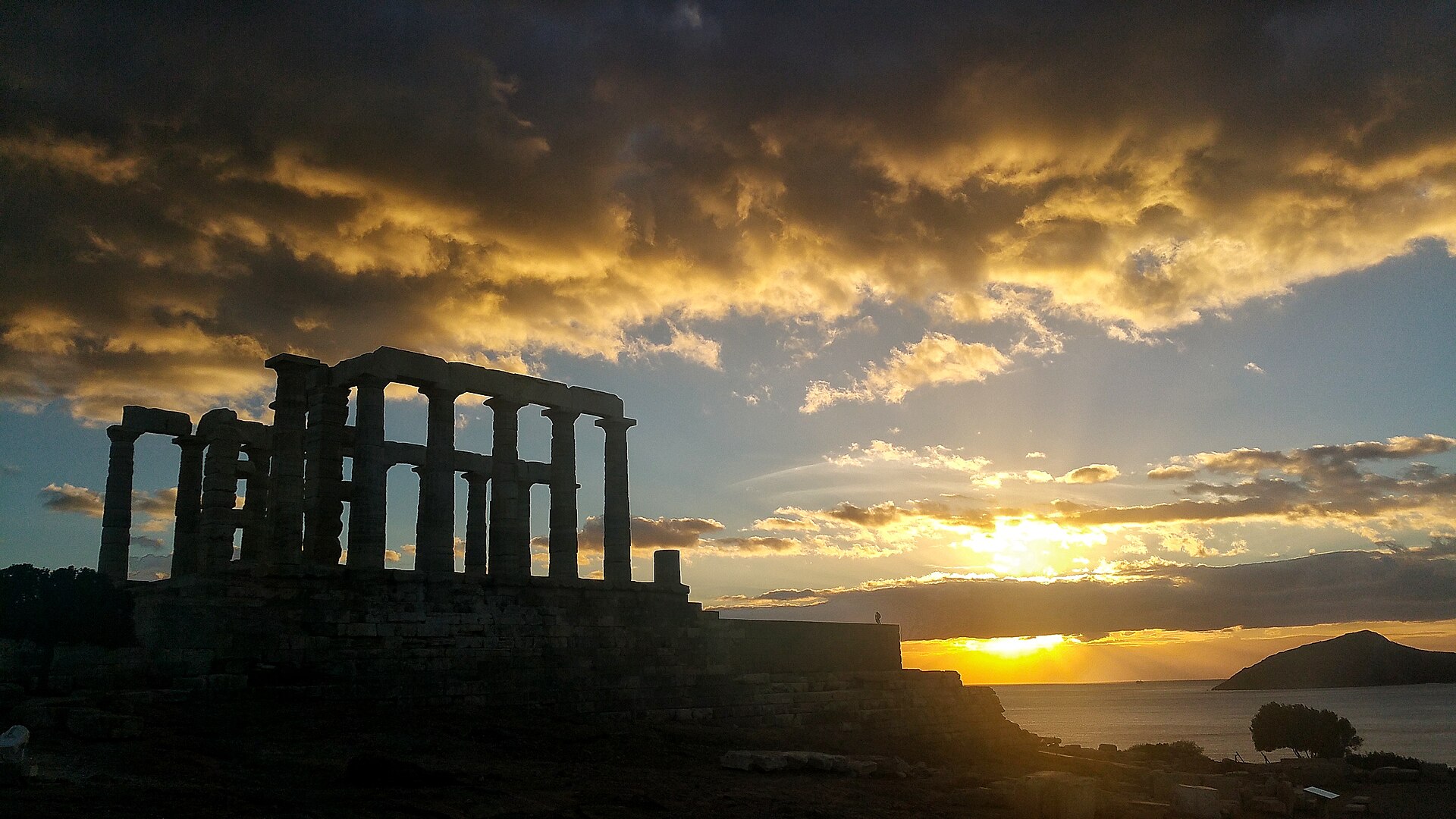
The most cinematic survival sits at the tip of Attica. At Cape Sounion, the Temple of Poseidon stands on a cliff above the sea, a marble landmark that ancient sailors watched for as they came and went. Legend tied it to Theseus's father, King Aegeus, who is said to have thrown himself from these heights when he saw the wrong-coloured sail and believed his son dead — giving the Aegean its name. Whether you read it as myth or as a sunset over the water, the place still does what it always did: it marks the edge of the Athenian world.
For the island side of the same imagination — the Cycladic figures and seafaring cultures that fed Greek myth — the Museum of Cycladic Art in central Athens is the natural complement, a quiet counterpoint to the heroic open-air sites.
Modern myths: the legends the neighbourhoods still keep
Myth-making did not stop with antiquity. Athens carries a second, quieter layer of legend — the urban kind, told in courtyards and cafes rather than temples. There are the stories of Plaka's tangled lanes and hidden gardens, of buried streams running unseen beneath the modern grid, of refugee quarters built almost overnight after 1922, of arcades and old literary cafes where writers and politicians argued the city into being.
These are everyday legends, the memory a place keeps about itself, and they are no less part of Athens than the contest on the rock. They explain why a particular staircase, a chapel wedged between apartment blocks, or a marble doorway feels charged with more than its size.
Taken together, the two layers make the same point. Athens has always understood itself through stories — divine and domestic — and walking the city is, in large part, the act of reading them. The monuments are the oldest chapters; the neighbourhoods are still writing new ones.
Reviewed source trail
- UNESCO World Heritage Centre — Acropolis, Athens (inscription and description) - checked 2026-09-12
- Acropolis Museum — The Parthenon frieze and the Panathenaic procession - checked 2026-09-12
- Hellenic Ministry of Culture (Odysseus) — Acropolis of Athens - checked 2026-09-12
- National Archaeological Museum, Athens — collections of Greek myth and antiquity - checked 2026-09-12
Last reviewed September 12, 2026