Reading the city in stone
Athens, Monument by Monument
From the marble crown of the Acropolis to neoclassical boulevards and major museums, Athens is an open archive you can walk through — every era left a layer you can still read.
The Acropolis: the crown and the argument
Everything in Athens orients itself around one rock. The Acropolis is not a single building but a composed ensemble — the Parthenon, the Erechtheion, the Propylaia gateway, and the small, precise Temple of Athena Nike — raised in the fifth century BC at the height of the classical city. It is the point where architecture, religion, and politics fuse into one statement, and the reason the site sits on the UNESCO World Heritage list as a global symbol of the classical spirit.
The Parthenon is the headline, but the Erechtheion is the one that rewards a second look: its asymmetric plan absorbs the older cults of the sacred rock, and its south porch is carried not by columns but by the Caryatids, six draped women turned into structure. The whole hill was conceived as a procession — you climb through the Propylaia and the buildings reveal themselves in sequence rather than all at once.
Read it less as a ruin than as an argument the city made about itself: that proportion, restraint, and public scale were worth building in marble. The current Parthenon you see is also a record of repair — decades of careful, reversible restoration are part of what the monument now is.
The south slope: where drama was invented
Walk down from the summit and the rock turns into a stage. The south slope holds the Theatre of Dionysus, where Greek tragedy and comedy were first performed — the literal birthplace of Western drama, the open-air auditorium where the plays of Aeschylus, Sophocles, Euripides, and Aristophanes premiered before the whole city.
A few steps along the same slope is the Odeon of Herodes Atticus, the steep stone theatre built under Roman patronage in the second century AD. Long a summer home of the Athens Festival, it hosted a farewell programme in June 2026 before a planned closure of several years for restoration. Between the two theatres, the slope tells you what Athens valued: this was a city of speech and spectacle, where being an audience was itself a civic act.
Agora, Kerameikos, and the working ancient city
The monuments on the hill were the sacred face of Athens; the level ground below was where the city actually lived. The Ancient Agora was its civic and commercial heart, presided over by the Temple of Hephaestus — the best-preserved Doric temple in Greece — and edged by the reconstructed Stoa of Attalos, a covered colonnade that shows how a public market and meeting hall really looked.
Nearby, the Roman Agora and the Library of Hadrian mark the moment Athens became a prestigious provincial city of the empire, kept as a kind of cultural university for the Roman world. Westward, the Kerameikos was the city's potters' quarter and principal cemetery, where a stretch of the ancient walls, the Sacred Way to Eleusis, and rows of grave monuments survive — the quietest and most atmospheric of the central sites.
Taken together these grounds let you trace the ordinary infrastructure of an ancient democracy: where people argued, traded, voted, and were buried, all within a short walk of the temples above them.
Hadrian, the marble stadium, and the neoclassical capital
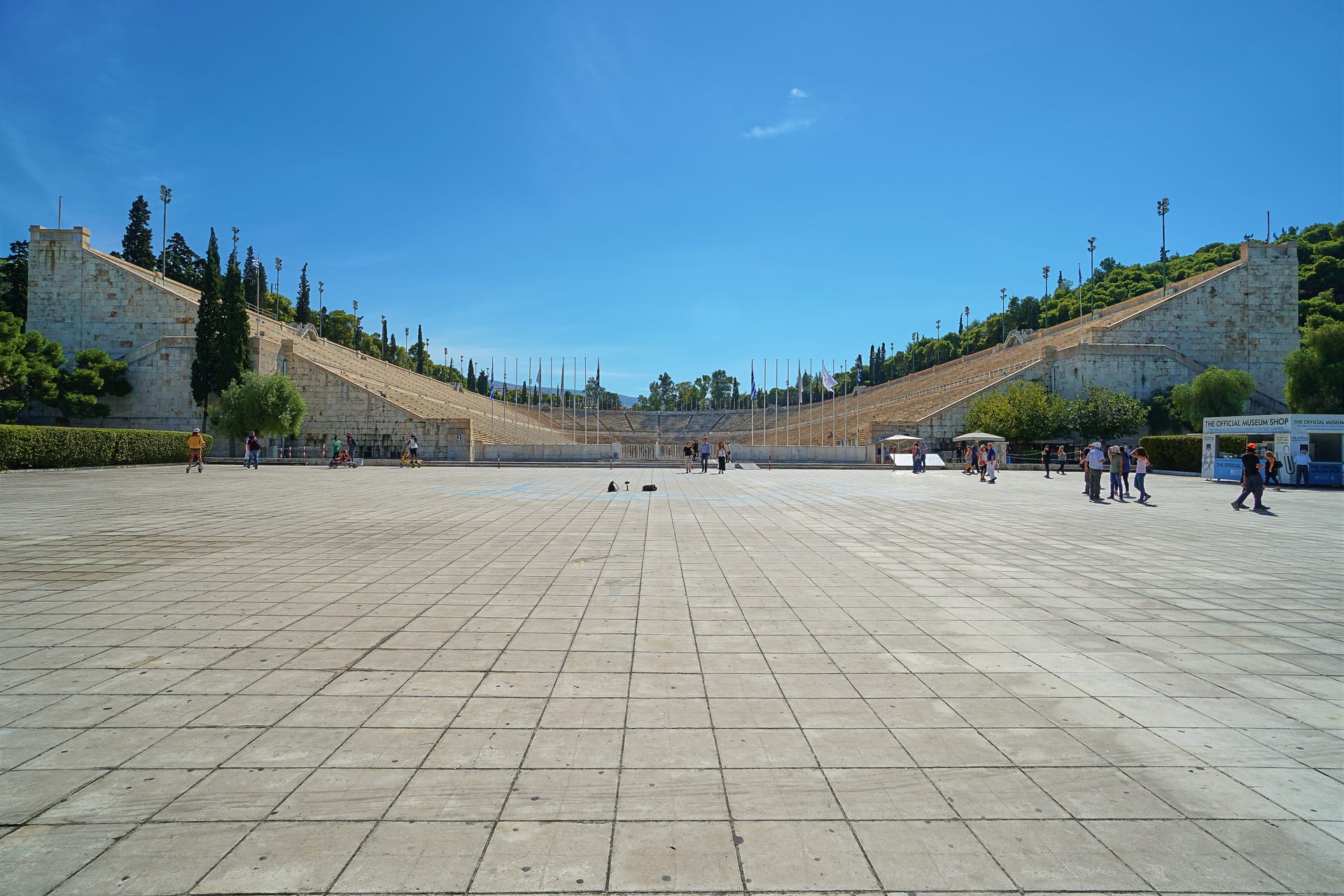
Athens keeps adding columns to its own colonnade. The Temple of Olympian Zeus (the Olympieion), finished under the emperor Hadrian, and the adjacent Arch of Hadrian record the Roman city's ambition; a short walk away, the Panathenaic Stadium — the Kallimarmaro, rebuilt entirely in white Pentelic marble — hosted the first modern Olympic Games in 1896 and ties the ancient city directly to the modern one.
When Athens became the capital of the new Greek state in 1834, it dressed itself in neoclassicism, consciously quoting the classical past it stood on. The 'Athenian Trilogy' on Panepistimiou Street — the University, the Academy, and the National Library — is the set piece, all pediments, Ionic columns, and painted detail.
But the honest twentieth-century city is here too, in the dense apartment blocks of the antiparochi building boom, the covered arcades (stoes) threaded through the center, and the refugee quarters built after 1922. The old town of Plaka, the tiny whitewashed houses of Anafiotika built by island masons from Anafi, and the bazaar streets of Monastiraki and Psyrri show a smaller, Cycladic scale surviving under the monuments.
The museums: where the loose pieces live
What time and weather have pulled off the monuments now lives indoors, and Athens holds one of the densest concentrations of great museums in Europe. The Acropolis Museum, at the foot of the rock, was purpose-built around its collection — its top-floor Parthenon Gallery aligns the surviving frieze with the temple itself, visible through the glass, and frames the debate over the sculptures still held abroad.
The National Archaeological Museum is the country's largest, the place to see Mycenaean gold, Cycladic figurines, and bronze masterpieces gathered from across the Greek world. The Museum of Cycladic Art makes the case for those spare, modern-looking marble figures, while the Benaki Museum of Greek Culture sweeps from antiquity through Byzantium to the modern era under one roof.
Add the Byzantine and Christian Museum, the National Gallery, and the specialist Numismatic and Epigraphic collections, and the picture is complete: Athens is not only a city of standing monuments but of curated memory, where the fragments are read, labeled, and kept.
Reviewed source trail
- UNESCO World Heritage Centre — Acropolis, Athens - checked 2026-09-12
- Acropolis Museum — official website - checked 2026-09-12
- National Archaeological Museum, Athens — official website - checked 2026-09-12
- Benaki Museum — official website - checked 2026-09-12
- Museum of Cycladic Art — official website - checked 2026-09-12
- Athens Epidaurus Festival — 2026 Odeon programme and restoration - checked 2026-09-12
Last reviewed September 12, 2026