Reading the city in strata
Athens, Read in Layers
Athens is not a single ancient city but a stack of them, each laid down on the last. Read in strata, the rock, the ruins, the churches, and the apartment blocks all turn out to be the same continuous story.
The rock came first
Long before there was a capital, there was a rock. The Acropolis limestone has been a place of settlement, worship, and defence for something like three and a half thousand years of recorded history, and that single outcrop explains why a city ever fixed itself here at all. Defensible on every side, with springs at its foot and a clear line of sight to the sea, it was the obvious place to gather, to pray, and to hold against attack.
The earliest Athens you can still trace is Mycenaean. In the Late Bronze Age the rock carried a fortified citadel ringed by massive walls, the kind of cyclopean masonry that later Greeks assumed only giants could have stacked. Fragments of that defensive circuit survive on the summit, beneath and around the classical monuments that would eventually crown it.
This is the first thing to understand about Athens: the famous fifth-century city was not built on empty ground. It was built on top of a citadel that was already ancient, on a rock that had already been sacred for a thousand years. Every later layer is laid over this one.
The classical century that the world still measures itself against
The Athens that shaped Western imagination was a project of the sixth and fifth centuries BC. The reforms of Solon and then Kleisthenes pushed the city toward democracy; the Persian Wars, fought off under Themistokles, gave it the confidence and the spoils to remake itself. Under Perikles, in a single extraordinary generation, the city rebuilt the Acropolis in marble.
What rose there, above all the Parthenon, became a worldwide symbol of the classical spirit, and the Acropolis is today inscribed on the UNESCO World Heritage list precisely as that universal reference point. It is worth remembering that the temple was the product of a working democracy, sculpted under Pheidias, funded by an empire, and argued over in an assembly.
Across the fifth and fourth centuries BC, Athens was home to successive generations of thinkers and playwrights: Socrates, Plato and Aristotle, and Aeschylus, Sophocles, Euripides and Aristophanes, whose plays were staged on the slope below the temples. The monuments and the ideas are not separate achievements. They are connected parts of the city’s classical flowering, and that is the layer most visitors come for.
Schools of philosophy and the gifts of Rome
Athens lost its political weight after the classical age, but it kept its prestige as a city of learning. Through the Hellenistic period and into Roman rule it remained the place ambitious young men of the Mediterranean came to study philosophy and rhetoric, a kind of university town of the ancient world that traded power for intellectual authority.
Rome treated Athens as a cultural patron treats a revered elder, and the emperors left their mark in stone. Hadrian endowed the city with his library and pushed to completion the colossal Temple of Olympian Zeus. The wealthy benefactor Herodes Atticus rebuilt the Panathenaic Stadium in marble in the second century AD and later gave the city the theatre that still carries his name on the south slope.
These are the layers that complicate the postcard. The ruins clustered around the rock are not all classical Greek; some of the grandest are Roman gifts, monuments to an age when Athens lived partly on the reputation of its own past.
The long middle: Byzantine, Frankish, Ottoman
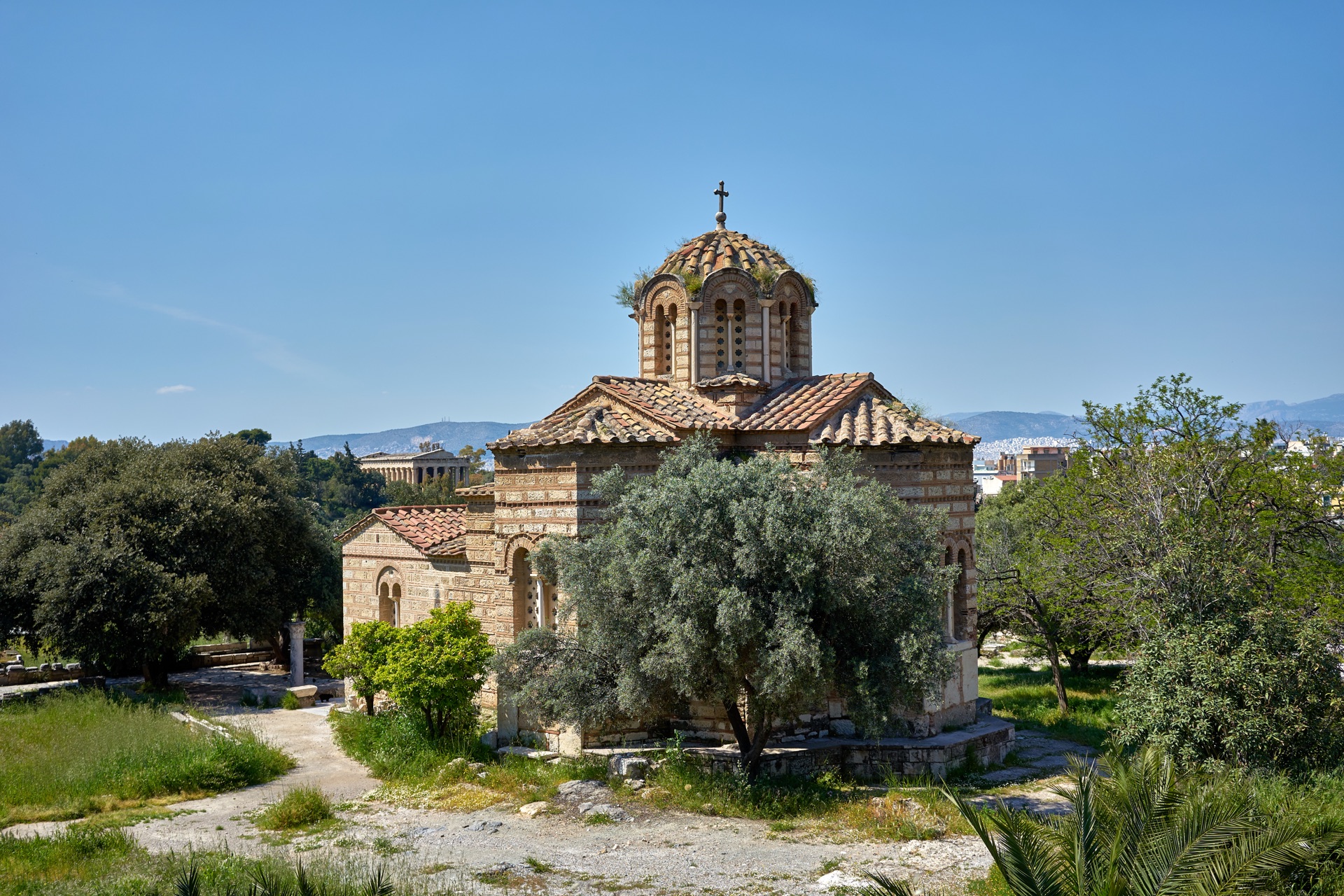
For more than a thousand years after antiquity, Athens shrank to a provincial town, but it never went silent. The city carried on under Byzantium, and its temples were converted rather than abandoned, the Parthenon itself serving as a Christian church for centuries. Small, domed Byzantine churches from this era still sit, half-sunk, among the modern streets of the centre.
The medieval city changed hands as the eastern Mediterranean did. After the Fourth Crusade and the fall of Constantinople in 1204, Athens became the seat of a Frankish Duchy, one more foreign overlay on a Greek town. Later, under Ottoman rule, the Acropolis served as a fortress, and the lower city acquired mosques, bathhouses, and bazaars.
This is the layer easiest to walk past and most rewarding to notice. A Byzantine chapel wedged between apartment blocks, a converted mosque on a market square, a stretch of Ottoman-era lane, these are the centuries that connect the ancient city to the modern one and keep the story continuous rather than broken in two.
The modern capital and the century that built today's city
Athens became the capital of the new Greek state in 1834, and a town of a few thousand around the foot of the Acropolis was suddenly asked to behave like a European capital. The nineteenth century answered with neoclassicism: palaces, the university, and the marble trilogy of public buildings that gave the modern city its first formal face.
The twentieth century then rewrote the map. The 1922 Asia Minor Catastrophe sent waves of refugees into the city and reshaped whole districts; occupation and civil war scarred it; and a long postwar surge of urbanisation, much of it through the antiparochi system of trading land for apartments, covered the basin in the dense apartment blocks that define Athens to this day. The 2004 Olympic Games, like the first modern Games of 1896 before them, marked another moment of the city remaking itself in public.
The point of reading Athens in layers is that none of this has been cleared away. The refugee quarter, the neoclassical facade, the Byzantine chapel, the Roman library, and the classical temple all share the same square kilometre. The city you walk is the whole stack at once, and once you can see the strata, the apparent chaos of central Athens starts to read as a legible history.
Reviewed source trail
- UNESCO World Heritage Centre — Acropolis, Athens - checked 2026-09-12
- Hellenic Ministry of Culture (Odysseus) — Acropolis of Athens - checked 2026-09-12
- Acropolis Museum — official website - checked 2026-09-12
- National Archaeological Museum, Athens — official website - checked 2026-09-12
- Hellenic Heritage — Aristotle’s Lyceum - checked 2026-09-12
- Athens Epidaurus Festival — 2026 Odeon programme and restoration - checked 2026-09-12
Last reviewed September 12, 2026