Daily life and the table
Athens at Street Level: Culture, Neighborhoods, and the Table
Beneath the monuments, Athens is a fast but sociable Mediterranean city of squares, markets, and neighborhood loyalties, with a table built from islands, mainland villages, and refugee kitchens. This is the living culture you actually walk into.
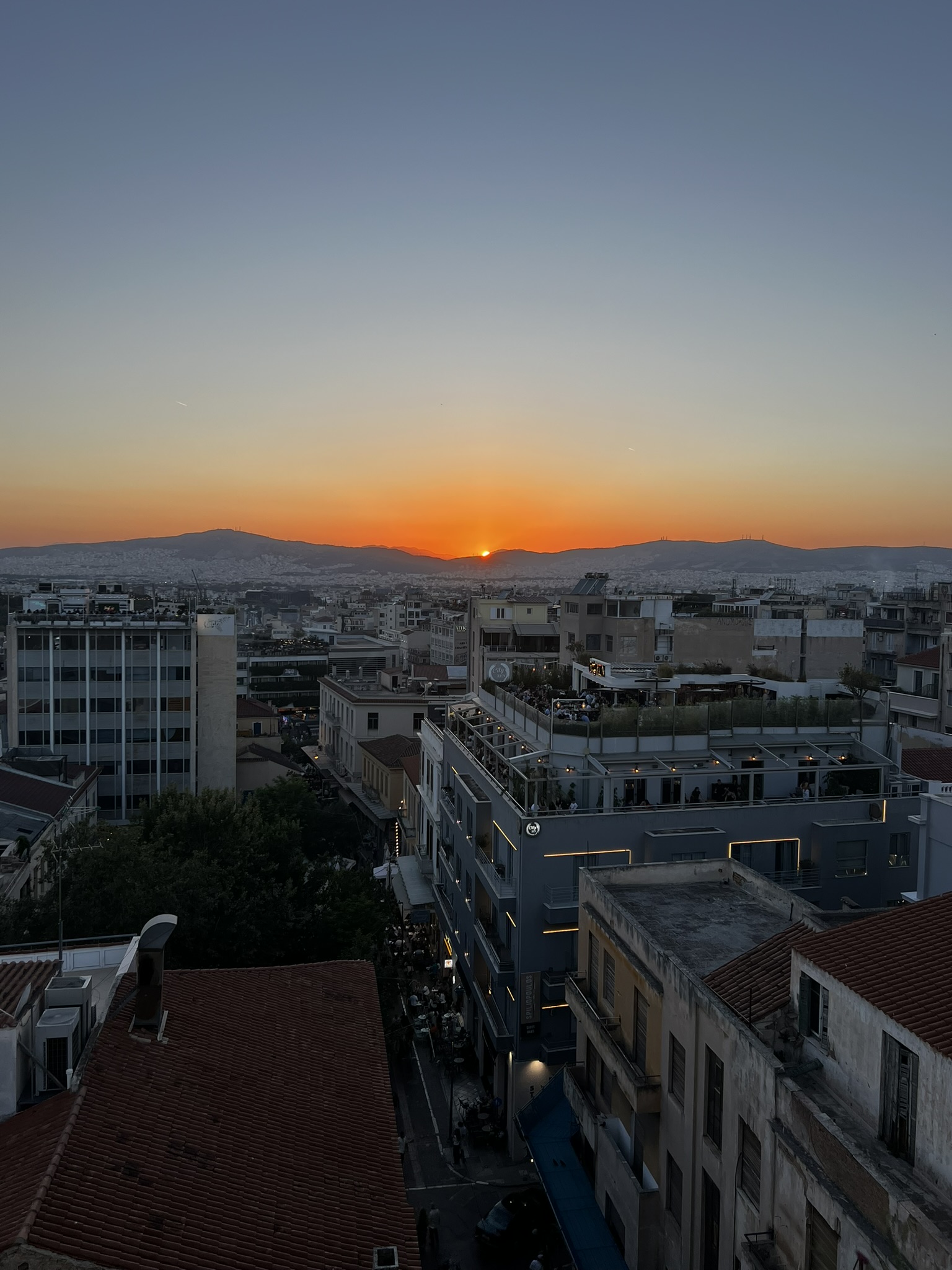
Life happens in public
Athens is a city that lives outdoors. The real arena of daily life is the public realm: squares and pedestrian streets, covered arcades and street-corner kiosks, open-air markets and the cafe table where a single coffee buys you an afternoon. The Athenian habit of spending hours in company over very little is not idleness but a social grammar, and it is the most reliable way for a visitor to read the city's rhythm.
That rhythm is fast but unhurried at once: dense, noisy, and quick on its feet, yet punctuated by small deliberate pauses. People move with purpose and then stop entirely to talk. The sense of geitonia, the neighborhood, runs deep here, and even in a metropolis of millions the city is experienced as a patchwork of villages, each with its own square, its own bakery, its own regulars.
This is the same instinct for public life that built the ancient city. The tradition of open, argumentative speech that began on the Pnyx and in the Agora never really left; it simply migrated to the universities, the theaters, and the cafe tables, where Athenians still treat conversation as a civic act.
Reading the neighborhoods
Each Athenian quarter carries a distinct character, and learning a few of them is the fastest way to feel oriented. Plaka and Monastiraki are the historic and commercial heart, where the old town's lanes thread between ruins, markets, and souvenir stalls. Koukaki sits in the shadow of the Acropolis and its museum and has quietly become one of the most walkable bases in the city.
Pangrati is a neighborhood of leafy squares and a strong local life; Kypseli is dense and multicultural; Exarcheia carries decades of political and artistic memory. Mets and Thiseio keep gentler, older scales, close to the archaeological core but a notch quieter than the tourist spine.
These textures matter for more than atmosphere. Where you stay shapes the whole trip, because Athens rewards walking and the difference between two adjacent quarters can be the difference between a calm morning coffee and a crush of foot traffic. Choosing a base is really choosing a daily rhythm.
A table built from elsewhere
Athenian food is urban and gloriously composite, a cuisine assembled from everyone who came to the city from somewhere else. Island fish-eating, mainland Epirot pies, and the deep memory of Asia Minor all meet here, the last carried by the refugee cooks who arrived after 1922 and reshaped the city's kitchens for good. The result ranges from humble mageireia serving the day's slow-cooked dishes to ouzo-and-meze tavernas, bakeries, sweet shops, and a confident new Greek cuisine.
The flavors that define a day in Athens are specific and unpretentious: the morning koulouri sesame ring bought from a street cart, souvlaki and gyros at lunch, plates of meze drawn out over ouzo or tsipouro, fresh seafood, and a sweet finish of loukoumades, galaktoboureko, or rizogalo. As part of the broader Mediterranean diet, which UNESCO inscribed on its list of the Intangible Cultural Heritage of Humanity, this is a food culture as much about how people eat together as what is on the plate.
Eating well in Athens is rarely about the expensive room. It is about knowing that the best gyro, the right bakery, and the long meze table are all within a short walk of each other, and that the meal is meant to be shared and unhurried.
The central market and the deli counter
If the neighborhoods are the city's living rooms, the Varvakeios Agora is its stomach. The central municipal market on Athinas Street has run almost without pause since the 1880s, and its halls of fish, meat, and produce, ringed by spice merchants, cheese sellers, and cured-fish stalls, are the clearest single window onto how Athens actually feeds itself.
Around and within the market sit the specialty counters and old delicatessens that anchor the city's appetite, the kind of place where a plate of cured meats and cheeses is still a meal in itself. These are working spaces first and attractions second, busiest in the morning and closed on Sundays, and they reward visitors who treat them as a market rather than a museum.
The market is also a good lesson in continuity. Athens has been a city of commerce and bargaining since antiquity, and the noise, the haggling, and the smell of grilling meat in the surrounding lanes are a direct line back to the agora as a place of exchange.
What Athenians drink
Attica is one of Europe's oldest wine landscapes, and its signature grape is Savatiano, the white variety that has long covered the vineyards of the Mesogeia plain east of the city. From it comes the wine most bound up with Athenian identity: retsina, the resin-touched white whose PGI Retsina of Attiki designation allows only Savatiano and Roditis, made by adding Aleppo-pine resin to the must.
Long dismissed as rough table wine, retsina has been quietly rehabilitated by a new generation of Attic producers, and a good chilled glass alongside meze is one of the most honestly local things you can drink in the city. Beyond the bottle, the cafe and the bar are central institutions in their own right, from old-school kafeneia to the rooftop and cocktail scene that now draws international attention.
The point is less the specific drink than the setting. Whether it is morning coffee, an ouzo at midday, or a late cocktail with the Acropolis lit behind the rooftops, Athenian drinking is social by default, the excuse rather than the object of the gathering.
A city of people who came from somewhere else
More than any monument, what gives Athens its character is its composition. This is a city of people who arrived from elsewhere: the Greeks of Asia Minor after 1922, waves of internal migrants from the islands and the mainland villages, generations of students and artists, and newer communities that keep reshaping its neighborhoods today. The city's culture is layered the way its archaeology is.
That layering shows up in the calendar and the street as much as in the kitchen. National parades and religious feasts, Easter processions and saints' days, fold into the ordinary week, and the tradition of public gathering, debate, and performance runs from the ancient assembly straight through to today's squares and stages.
The honest summary is that Athens refuses a single label. It is ancient and contemporary, working-class and intellectual, noisy and reflective, all at the same time. Understanding that is the difference between seeing Athens as the city of the Acropolis and experiencing it as a full place to live in for a few days.
Reviewed source trail
- This Is Athens — Athens central food market (Varvakeios) - checked 2026-09-12
- UNESCO Intangible Cultural Heritage — Mediterranean diet (Greece inscribed) - checked 2026-09-15
- Wines of Greece — PGI Retsina of Attika - checked 2026-09-15
- Wines of Greece — Savatiano - checked 2026-09-15
Last reviewed September 15, 2026